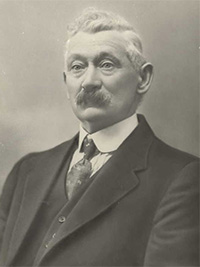
James Cedric Illingworth

M, #25201, b. 1907, d. 1966
Father*James Illingworth b. 1880, d. 4 Jun 1919
Mother*Nell Gwynne Decis d. 7 Jun 1938
Birth*1907 Fremantle, WA, Australia, #B647/1907.1 
Marriage-Notice*3 Nov 1927 ILLINGWORTH-FREEMAN.—On August 4, 1927, at Catholic Church, Carnarvon, by the Rev. Father John, James Cedric Illingworth, only son of the late Private James Illingworth, and Mrs. Nell Gwynne, Belperroud, late Hotel Claremont, to Edith (Lovie) Freeman, third daughter of Mr and Mrs W. Freeman of Carnarvon. Present Address Port Hedland.2 
Death*1966 Perth, WA, Australia, #D2365/1966 (Age 62) [par James & Nell G].1 

Citations

  1. [S62] Western Australian Government. BDM Index Western Australia.
  2. [S14] Newspaper - Western Mail (Perth, WA), Thu 3 Nov 1927, p40
    https://trove.nla.gov.au/newspaper/article/37671413
Last Edited2 Jan 2022

Thomas Butler

M, #25210, b. 1834, d. 17 May 1907
Probate (Will)* 102/637. Thomas Butler, Residence: Berwick, Occupation: Labourer, Date Of Death: 17 May 1907, Date Of Grant: 20 Jun 1907
formerly of Gembrook but late of Berwick. Leaves his property to his nephews Richard and Tom Turner, sons of Thomas Turner, carddresser of Norwood Green near Halifax Yorkshire. Personal estate not exceeding £159. The land (unimproved) was valued at £10. He had been lodging with Mrs Bain.1 
Birth*1834 Yorkshire, England. 
Land-Berwick*14 Jul 1879 BER-Crown-18 (part) tx 79714. Transfer from George Brown to Thomas Butler. 2r 16p.2 
Land-Berwick*15 Jun 1885 BER-Crown-18 (part) tx 149733. Transfer from Thomas Butler to Thomas George Perrett. 2r 16p.3 
Land-Berwick*22 Apr 1891 BER-Town S4-10. Transfer from William Galloway to Thomas Butler. 0a 2r 0p.4 
Death*17 May 1907 Berwick, VIC, Australia, #D3734/1907 (Age 73) (par unknown) - as Thos BUTLER.5 
Land-Note*16 Nov 1909 BER-Town S4-10. Memo No 44755. Walter Henry Fossey of 93 Grosvenor Street Balaclava Bank Clerk is registered as proprietor of the within-described land as Executor to whom Probate of the will of Thomas Butler (who died on the 17th day of May 1907) was granted 20th day of June 1907. Dated 16th day of November 1909.6 
Land-Berwick*13 Aug 1914 BER-Town S4-10. Transfer from Thomas Butler to Henry John Lee. 0a 2r 0p.7 

Grave

  • 3-584-A, Berwick Cemetery, Berwick, VIC8

Citations

  1. [S35] Probate Records, PROV (Public Record Office Victoria), Probate and Administration Files (VPRS28) / Wills (VPRS7591)
    102/637. Thomas Butler, Residence: Berwick, Occupation: Labourer, Date Of Death: 17 May 1907, Date Of Grant: 20 Jun 1907
    VPRS 28/P0002, 102/637; VPRS 28/P0000, 102/637; VPRS 7591/P0002, 102/637.
  2. [S185] Property Titles ; PROV (Public Record Office Victoria), C/T 1119-679 - Thomas Butler of Berwick Brickmaker (parent title 1016-156).
  3. [S185] Property Titles ; PROV (Public Record Office Victoria), C/T 1119-679 - Thomas George Perrett - see C/T 1708-477.
  4. [S185] Property Titles ; PROV (Public Record Office Victoria), C/T 1119-636 - Thomas Butler of Berwick Labourer.
  5. [S28] Victorian Government. BDM Index Victoria (Deaths) (online) "#D3734/1907 (Age 73) (par unknown) - as Thos BUTLER, Death registered at Berwick, Australia."
  6. [S185] Property Titles ; PROV (Public Record Office Victoria), C/T 1119-636 - Memo No 44755. Walter Henry Fossey of 93 Grosvenor Street Balaclava Bank Clerk is registered as proprietor of the within-described land as Executor to whom Probate of the will of Thomas Butler (who died on the 17th day of May 1907) was granted 20th day of June 1907. Dated 16th day of November 1909.
  7. [S185] Property Titles ; PROV (Public Record Office Victoria), C/T 1119-636 - Henry John Lee of Berwick Gentleman.
  8. [S44] Index of burials in the cemetery of Berwick,
    3-584-A Butler J. M 73 18/05/1907 419.
Last Edited28 Nov 2024

Thomas George Perrett

M, #25211
Land-Berwick*15 Jun 1885 BER-Crown-18 (part) tx 149733. Transfer from Thomas Butler to Thomas George Perrett. 2r 16p.1 

Citations

  1. [S185] Property Titles ; PROV (Public Record Office Victoria), C/T 1119-679 - Thomas George Perrett - see C/T 1708-477.
Last Edited8 Oct 2020

John William Fritzlaff

M, #25212, b. 1858, d. 29 Jul 1941
Birth*1858 Harkaway, VIC, Australia.1 
(Transfer to) Land-Berwick11 Dec 1869 BER-Crown 8 (part). Transfer from Ernst Gottlob Wanke to Louis Linsing, Ernest Gottlieb Hillbrick, John William Fritzlaff, Henry Edebohls, Peter Heinrich Erdmann. Conveyance in trust for chapel school and similar purposes. Consideration £1. Measuring 100 links by 100 links.2 
Marriage*1885 Spouse: Ellen Brown. VIC, Australia, #M2183/1885.3
 
Land-Berwick*7 Sep 1887 BER-Crown-18 (part) tx 196164. Transfer from George Brown to John William Fritzlaff. 1a - cnr Clyde Road / Langmore Lane.4 
Land-Note*30 Sep 1897 BER-Crown-18 (part): Mortgagee: Immanuel Gottlieb Wanke. Mortgage 180084. Discharged 3 Aug 1906. Mortgagor was John William Fritzlaff.5 
Land-Berwick*3 Apr 1906 BER-Crown-18 (part). Transfer from John William Fritzlaff to Nathalia Bertha Wanke. 1a.6 
Death*29 Jul 1941 Malvern, VIC, Australia, #D7023/1941 (Age 83) [par John Martin Frederick FRITZLAFF & Johanna RIEGER].1 
Death-Notice*2 Aug 1941 FRITZLAFF.—On July 29, at his residence, High-street, Malvern, John William, dearly loved husband of Ellen, and loving father of Lottie (Mrs. Tipton), Alfred and Frank (deceased), aged 83 years. At rest.7 

Citations

  1. [S28] Victorian Government. BDM Index Victoria (Deaths) (online) "#D7023/1941 - born HARKAWAY."
  2. [S185] Property Titles ; PROV (Public Record Office Victoria), AP 11039 - Memorial 196.783.
  3. [S27] Victorian Government. BDM Index Victoria (Marriages) (online).
  4. [S185] Property Titles ; PROV (Public Record Office Victoria), C/T 1944-607 - John William Fritzlaff Carpenter (parent title 1016-156).
  5. [S185] Property Titles ; PROV (Public Record Office Victoria), C/T 1944-607 - Mortgage 180084 - discharged 3 Aug 1906, when it was transferred to Bertha Wanke.
  6. [S185] Property Titles ; PROV (Public Record Office Victoria), C/T 1944-607 - Bertha Wanke wife of Immanuel Wanke of Harkaway Farmer.
  7. [S16] Newspaper - The Age (Melbourne, Vic.), Sat 2 Aug 1941, p1
    https://trove.nla.gov.au/newspaper/article/205172440
Last Edited26 Jun 2025

Ellen Brown

F, #25213, b. 1865, d. 11 Dec 1944
Married NameEllen Fritzlaff. 
Birth*1865 
Marriage*1885 Spouse: John William Fritzlaff. VIC, Australia, #M2183/1885.1
 
Widow29 Jul 1941Ellen Brown became a widow upon the death of her husband John William Fritzlaff.2 
Death*11 Dec 1944 Armadale, VIC, Australia, #D12613/1944 (Age 79) [par William Martin BROWN & Ellen BARRY].3 
Death-Notice*13 Dec 1944 FRITZLAFF.–On December 11, at St. Ronan's, Malvern, Ellen, beloved wife of the late John William Fritzlaff. loving mother of Lottie (Mrs. L. H. Tipton), Alfred, and Frank (deceased), and loving grandmother of Norman and Patricia. (Privately interred.)4 

Citations

  1. [S27] Victorian Government. BDM Index Victoria (Marriages) (online).
  2. [S28] Victorian Government. BDM Index Victoria (Deaths) (online) "#D7023/1941 - born HARKAWAY."
  3. [S28] Victorian Government. BDM Index Victoria (Deaths) (online) "#D12613/1944 - born BERWICK."
  4. [S11] Newspaper - The Argus (Melbourne, Vic.), Wed 13 Dec 1944, p11
    https://trove.nla.gov.au/newspaper/article/11374555
Last Edited8 Oct 2020

Immanuel Gottlieb Wanke

M, #25214, b. 24 May 1856, d. 24 Jun 1934
Father*Ernst Gottlob Wanke b. 1823, d. 6 Aug 1897
Mother*Paulina Wilhelmina Schumann b. 1822, d. 9 Sep 1904
Birth*24 May 1856 Harkaway, VIC, Australia, #B7210/1856 [par Gottlob WANKE & Paulina SCHUMANN] - reg Berwick - Gottlob Immanuel WANKE.1 
Land-Note*8 Jan 1861 BER-Crown 9 (part): Mortgagee: Immanuel Gottlieb Wanke. £150. Discharged 6 May 1863. Mortgagor was Gottlieb Weist.2 
Land-Berwick*21 Jun 1866 BER-Crown 8 (part). Transfer from Immanuel Gottlieb Wanke to Louis Linsing. Consideration £99 - parcel of land N 1493 links; E 1550 links; to W 1000 links; to S 1950 links; to W 493 links; to N 3500 links. Some land to the north already in Linsing's ownership.3 
Land-Berwick*21 Dec 1874 BER-Crown 9 (part). Transfer from Gottlieb Weist to Immanuel Gottlieb Wanke. Consideration £100 - parcel of land 375 links by 5300 1/3 links SW corner of JA's land.4 
Land-Berwick*30 Dec 1876 BER-Crown 9 (part). Transfer from Immanuel Gottlieb Wanke to John Lindau. Consideration £130 - parcel of land 375 links by 5300 1/3 links SW corner of JA's land.5 
Marriage*1879 Spouse: Nathalia Bertha Aurisch. VIC, Australia, #M2370/1879, Nathalia Bertha AURISCH & Gottlob Immanuel WANKE.6
 
Land-Note*30 Sep 1897 BER-Crown-18 (part): Mortgagee: Immanuel Gottlieb Wanke. Mortgage 180084. Discharged 3 Aug 1906. Mortgagor was John William Fritzlaff.7 
Land-Note*2 Oct 1902 BER-Crown-18 (part), cnr Station and Brown Streets: Mortgagee: Immanuel Gottlieb Wanke. Mortgage No 214089. Discharged 24 Feb 1922. Mortgagor was Otto Carl Heinrich Fritzlaff.8 
Land-Berwick*29 Aug 1905 BER-Crown 9 (part). Transfer from Elizabetha Durling to Immanuel Gottlieb Wanke. Price not listed.9 
Death*24 Jun 1934 Berwick, VIC, Australia, #D14032/1934 (Age 78) [par Gottlieb WANKE & Pauline KRATYMANN].10 
Death-Notice26 Jun 1934 WANKE.—On the 24th June, at his residence, Hillcroft, Narre Warren. Immanuel Gottlieb beloved husband of Bertha Nathalie Wanke (nee Aurisch), and loving father of Pauline (deceased), Emma (deceased), Magdalina (deceased), Herman, Ernst (deceased), Alfred (deceased), Oscar, Arthur, Frederick (killed in action), Minna, Edward, Herbert, Emelie, Harold, Adelaide. - Deeply mourned.
WANKE. - Friends of the late Mr. IMMANUAL GOTTLIEB WANKE are respectfully informed that his remains will be interred in the Harkaway Cemerery. Funeral to leave his residence, Hillcroft, Narre Warren, To-morrow (Wednesday, June 27), at 2:30.
JOHN GRANT, Undertaker, Berwick. Phone 25.11 
Death-Notice*7 Jul 1934 Am 24. Juni verschied Herr Immanuel Gottlieb Wanke, Hillcroft, Narre Warren.12 

Family

Nathalia Bertha Aurisch b. 1857, d. 16 Sep 1950
Children 1.Herman Immanuel Wanke+ b. 1883, d. 31 Jul 1974
 2.Oscar Wilfred Wanke23 b. 18 Jul 1887, d. 20 Jun 1970

Newspaper-Articles

  • 3 Sep 1887: The Northcote Dairy Company have an important notice in another column with reference to their old established business at the corner of Williams-road and Mackay-street, East Prahran.
    The proprietor, Mr J. R. Walker, has spared no expense in making the plant one of the most complete in the district, and the excellent quality of milk supplied naturally creates a large business.13
  • 17 Sep 1887: OUR MILK SUPPLY. A DAY WITH THE MILKMAN.
    The shrill and somewhat musical cry of the morning milkboy is familiar to all citizens, but beyond this, few are aware of the importance of the industry involved in the supply of the necessary lacteal product. As the season is now approaching when we may look forward to the reappearance of the dreaded typhoid fever, the spread of which is attributed by the medical faculty to be in a great measure due to the germs of the disease contained in some of the milk supplied to the public. Some particulars regarding the production and supply of one of our leading milkmen will no doubt prove doubly interesting to our readers. At the invitation of Mr J. R. Walker, proprietor of the Northcote dairy, one of our representatives last week paid a visit to that extensive establishment, which is situated at the corner of Williams-road and Mackay-street, East Prahran. The original establishment was located at Northcote, where three years ago, Mr Walker started with two carts, and an output of about 130 quarts daily, but the success attained during that brief period has been so great that the output is now 1800 quarts daily, Sunday included, which requires ten carts to deliver. The now establishment, which has been occupied since March, stands on a frontage of 51 ft., by a depth of 103 ft:, and is situated in a dry and healthy locality. On part of the land facing Williams-road Mr Walker has built a handsome and substantial ten-roomed villa, for his own use. At the rear is the milk dairy, which is built on the courtyard principle, and so constructed that the area available is devoted to the best advantage, comprising in addition to the milk rooms and offices, an extensive cart shed, and thirteen-stall stable, on the ground flat, while above these is a large forage loft, and drivers' sleeping apartment, the whole being constructed on the most modern principle, and supplied with every convenience. The yard is paved with stone, and a look of general cleanliness and good management meets the eye every where. In reply to our inquiry Mr Walker informs us that he does not keep a single cow on the premises, all the milk being supplied to him by contract, from Berwick and Narre Warren, by six different farmers. "Perhaps you would like to inspect the fountain heads," said Mr Walker, and on replying that we should be pleased to do so, it was arranged that we should start the following morning for Narre Warren, which is situated on the Gippsland line, about twenty miles from Hawksburn station, and thence drive round and view the various sources of supply. We accordingly started by the seven o'clock train on Thursday morning, and in about an hour arrived at Narre Warren. A few minutes' walk from the station brings us to "Stewartfield," the farm of Mr S. R. Prowse, where we receive a genuine farmers welcome, and are immediately shown over an extensive milking shed. The cows (54 in number) have just been milked, but are still bailed up, indulging in their morning feed, consisting of steamed bran and chaff, prepared in a cistern specially constructed for the purpose, bay, mangel wurzels, sweet turnips, and green fodder, the great bulk of which is grown on the farm. Mr Prowse, who is a strong advocate of good feeding, maintains that by judicious care and plenty of feed, the yield of milk from 50 cows exceeds that of 70 allowed to forage about for themselves, besides producing purer and richer milk. The cows, a sleek looking and well-conditioned herd certainly present a striking contrast to the miserable half starved animals that are sometimes seen foraging about the gutters in the city.
    Mr Prowse, although holding a large area of land, devotes his whole attention to the milk business, and supplies Mr Walker with about 320 quarts daily. After doing justice to a good breakfast provided by the amiable Mrs Prowse, we jump into Mr Prowse's waggonette, and drive to the farm of Mr E. Hillbrick, who, together with his brother who occupies an adjoining farm, supply Mr Walker with a large quantity of milk. Here we are kindly shown over the establishment, and gain further information on dairy farming.
    The Messrs. Hilbrick have followed up the industry for a long time, and likewise devote their entire attention to the business, having over 100 cows milking, although the proportionate yield does not equal that of Mr Prowse. The next farm visited is "Harkaway," the property of Mr Wanke. This gentleman has about 40 cows, a well-selected lot, which are well cared for and give a large yield. The modus operandi here is similar to the other places visited, except that the cows are housed at night, and bedded down with straw. In addition to supplying milk to Mr Walker, Mr Wanke has a large orchard and vineyard, and in addition to this, and placing part of the area under cultivation, he manufactures a large quantity of cheese at certain seasons of the year, possessing a first-class plant for the purpose. After saying good-bye to Mr Wanke, we start for Glady's Park, situated about four miles off, about two miles from Berwick station. Glady's Park is the property of Mr Stratford Strettle, but during the absence of that gentleman on a continental tour, it has been let to Mr E. Martin, a gentleman well known in squatting and sporting circles. The property comprises an area of about 650 acres, and possesses all the surroundings of a gentleman's country residence. The situation is picturesque, and the elegantly furnished homestead is, surrounded by a well-kept flower garden, which is just coming into its spring bloom, Mr Martin extends us a warm welcome, but wishing to catch the 11.30 train back to Hawksburn from Berwick, our time will only permit us to avail ourselves of a hurried glance around, and a reviver. Mr Martin has only recently gone into the dairying business, and seems to have spared no expense in erecting sheds, tanks, coppers, etc. His herd consists of upwards of 100 head, but a number of these are now dry. He admits not yet possessing the same practical knowledge and experience as Mr Prowse, but hopes in time to considerably increase his yield, and it must be said that failure in this direction is not likely to be brought about by want of enterprise or facilities. Leaving Mr Martin's, a sharp drive of two miles—during which we received a good baptism of Berwick mud, the roads being very heavy—we arrive at the Berwick railway station, and while waiting for the 11.30 train, see several of Mr Walker's milk consignments, the result of the mornings milking, entrained in a goods train which reaches Hawksburn about 1.15 p.m., being passed by the passenger train at Narre Warren, where the supplies of Messrs. Prowse, Hilbrick, and Wanke, are put on.
    On arrival at Hawksburn we find all Mr Walker's carts backed up to receive their various supplies. The whole consignment is received by Mr Walker's clerk, who after taking an inventory of the quantities, hands it over to the drivers, who then proceed to deliver it direct to the consumers, throughout the city of Melbourne, and the suburbs of Prahran, Windsor, St. Kilda, Balaclava, South Yarra, Toorak and Armadale. There are two milkings' daily, the first for the afternoon supply being that which takes places about 8 in the morning, and the second which constitutes the morning delivery, about 5 in the afternoon, which arrives at the Hawksburn station at 11 o'clock in the evening preceding delivery. Before being entrained, the natural heat is taken from the milk by placing the cans in tanks of water, which prevents it turning sour. Only the surplus milk is taken to Mr Walker's, and this is generally placed in pans and skimmed for the cream. The sum paid annually by Mr Walker for milk, at the rate of 1800 quarts daily, amounts to about £8000, and as some sixteen hands are employed on the premises, and a dozen horses and carts kept, some idea may be formed of the business done.14
  • 28 Mar 1891: PROSPECT FARM DAIRY
    BUNDOORA; ESTABLISHED 1872.
    Proprietor: J. R. WALKER,
    WHOLESALE AND RETAIL DAIRYMAN,
    Late of Northcote Dairy, Williams Road, Prahran.
    J. R. WALKER desires to inform the residents of Hawksburn, Toorak, South Yarra, Windsor, St. Kilda, Armadale, and surrounding neighbourhood that owing to the very numerous solicitations of former customers he has again entered into business as Dairyman, and is prepared to supply Milk of the very best quality, hoping that the liberal patronage bestowed upon him when conducting the Northcote Dairy will be accorded to him at is new address - Corner of HOWITT STREET
    & WILLIAMS ROAD, Near Hawksburn Station, (the premises lately occupied by Mr S. F. Reynolds.) Milk supplied to all suburbs Twice Daily. Postal cards will receive prompt attention.15
  • 25 Mar 1893: MELBOURNE. HINTS FOR PRODUCERS.
    I visited recently the Northcote Dairy Company's establishment at Hawksburn—one of the largest retail depots in Melbourne—where I picked up a few useful hints respecting the milk supply of the metropolis. The milk trade is doubtless one of the most important in the city, and it has also a close connection with farming along the various railway lines far into the country. For a radius of 50 miles around Melbourne there is scarcely a farmer but what has something or other to do with the milk traffic. And I may remark that some very useful lessons with respect to the management and feeding of the cows employed in this milk business are to be learned by dairymen further away who are more directly engaged in the making of butter and cheese.
    The milk-delivery men of Melbourne are generally smart and clean. Watch them, and they are down from the cart long before it has stopped, and on to it again like a bird after it has started, while the pace they drive at, as a rule, is proof that their horses are thoroughly sound in wind and limb.
    The milkman's work is probably neither hard nor arduous, but his hours are most irregular. At the Northcote Dairy Company's establishment operations commence daily at 3 a.m., and finish about 8 p.m. The milk has to be brought from the railway station at the hour stated every morning, the cans having arrived in the night from various parts of the country. Then the horses are to feed and harness, the carts to be loaded, and the driver in his seat, with the punctuality of clock-work. The same routine is gone through in the afternoon. Customers object to their milkman koo-ooo-ing too early in the morning, and yet they insist on having their milk delivered in time for breakfast. The deliveries have all to be executed within a couple of hours, which necessitates the employment of a large staff of both men and horses; and this is evidently one of the main reasons why consumers have to pay so much higher for their milk than the producer receives. So much for the city work.
    Let us now go to the country where the milk is produced. Mr. Rhutè, the manager of the Northcote Dairy Company, was kind enough to accompany me the other day to Narre Warren; a station on the East Gippsland line, 24 miles from Melbourne, where a large proportion of his milk is obtained from Mr. Wanke, who is one of the largest and most skilful dairy-farmers in that district. On this farm the production of milk is the object aimed at every day in the year. The cows are not maintained here for ornament, or simply to keep down the grass. Mr. Wanke has a certain quantity of milk to despatch to Melbourne twice every day, and all his energies are devoted to that purpose. He has succeeded so well that a brief outline of his system of management will perhaps prove interesting to dairymen in other parts of the country.
    The foundation of the business, after having selected the cows properly, rests on food. For a part of the year the grass, which in this locality is very luxuriant and rich for some months, is relied upon, but for the rest of the year the cows are fed artificially or by hand. Hay is grown extensively, and so are maize, turnips, and mangels. In the present season, owing to the long drought prevailing, the maize crops, which have been sown at various periods, and the root crops as well, are next door to failures. But Mr. Wanke is too experienced a farmer to be caught napping by any unusual freak in the weather. He has three big stacks of ensilage, one of which he is presently feeding to his cows, and without which he says he would now have been unable to maintain the cows in milk except at great expense for other foods, such as bran and chaff. He has now a very high opinion of ensilage, and he makes it simply by building up a stack of green grass and oats, and weighting it with some logs and stones. The sides are trimmed with a hay knife, and there appears to be no waste whatever.
    Yet, although Mr. Wanke has plenty of ensilage, he does not believe in the practice of feeding his cattle on that food alone. He mixes it with bran, and crushed oats, and chopped maize or mangels. The two latter are almost unnoticeable in the ration this season, but still they are there; in favourable years, when they are more plentiful, they would most probably predominate. Now that is the method—and it is a very simple one, when all is said and done—how good milk and plenty of it is most cheaply produced.
    It is often asserted that the secret of profit able milk production lies in the breed of cattle employed. Good blood certainly does count for something; but the so-called scrubber, if she be equally well fed, changes her character completely. As a rule, the successful dairymen in Gippsland or other parts of this country have no pure-bred cows on their premises. They generally keep a pure Ayrshire or Jersey bull, and the most promising heifer calves only are reared, the rest being sent early to the butcher or knocked on the head and buried. However, all those who engage solely in the milk trade generally find it cheaper to buy their cows than to rear them.
    The dairymen of this country, and I refer to those engaged in the milk traffic, might with advantage adopt the plan much followed by the town dairymen in the old country. There many of the dairies are situated in the city or suburbs, and the cows very often never see daylight outside from the day they enter till they leave the premises fat for the butcher. No calves are bred or reared. The dairyman keeps say 20 cows in his byre or stable. He buys each animal separately just newly calved; it matters little whether the beast is aged or in her prime—young heifers are not suitable—so long as she is likely to yield a lot of milk for the next 10 months, and can be secured at a reasonable price.
    From the day the cow enters the milk man's stable he commences to fatten her for the butcher on soft food, such as brewers' grains, bran, and meals of various kinds, and roots, all mixed and mashed together. On this diet the cows, for a long time, yield enormous quantities of milk, but they gradually dry off, and, the feed being still maintained, they soon grow fat and fit for the butcher. By the time a cow ceases milking she is plump and heavy. The fatted cow can then be readily sold for as much, and sometimes more, than she cost when purchased at the calving. The dairyman, therefore, loses nothing in this transaction or renewing or maintaining his herd, while he gains his profit by the great quantity of milk produced, and also from the fact that he has no young or dry stock to maintain.16
  • 18 Aug 1900: THE NORTHCOTE DAIRY, A MODEL DAIRY.
    On reference to another column of this journal the advertisement of the Northcote Dairy Company will be seen. Last week one of our representatives, through the courtesy of the proprietor (Mr. Wanke), was shown over the extensive premises; which, even in the smallest detail, showed that Mr. Wanke had neglected nothing. On entering the dairy the first thing the visitor is struck with is the fact that everything is the acme of convenience and cleanliness. The well-pitched yard is drained with agricultural pipes, and the fact that it is possible to flush it all over, thereby scouring, away any germs, or deleterious matter which would otherwise find lodgment, ensures its absolute cleanliness in summer or winter. Passing on to the stables, which contains accommodation for the nine horses employed in the distribution of the milk on the numerous rounds, the same scrupulous cleanliness was observed at every turn, so much so that every stall is disinfected, which practice obtains daily. The dairy proper, or house in which the milk is stored preparatory to delivery, is built on the very latest and up-to-date principles, and is so constructed that, even on the hottest day of summer, an equable temperature is assured, milk, as is well known, being one of those articles of food which is more readily affected by excentricities of temperature. The ten-gallon cans which contain the milk as sent from the farm are all purified and cleansed by a special steam apparatus before being returned.
    A well-known writer has said, "The necessity of a good milk supply has been pointed out a thousand times, and a milk supply that is above the suspicion of having been tampered with is only attained by the greatest care, the utmost vigilance and constant expense on behalf of milk-vendors." More than half the babies of the commnunity are reared on milk other than that which is natural to them. The complex cares of life renders the average mother unfit to properly discharge the duties of maternity, and the consequence is that the average baby has to rely on cow's milk. It will at once be seen that if the source of supply is tainted, if the supply is weakened by, say, the addition of water, then the welfare of thousands of infants is imperilled. Then, apart from babies, a pure supply of milk is absolutely necessary to many invalids, and some robust people deem a glass of milk—even if not diluted with "heather dew"—a wholesome addition to the daily existence. En passant we might say that in this respect Mr. Wanke stands unique, he being not only a distributor of milk, but also a producer. His farm, "Hill Croft" by name, at Narre Warren, is one of the best kept and most modernly worked farms in that well-known dairying district; and if Mr. Wanke's customers could only see the splendid paddocks of rich grass, the beautiful undulating country, and the class of dairy cattle Alderseys and Ayrshires—they would at once recognise that they were getting the very best and purest milk it is possible to obtain. It is probably known ... any (line unreadable) dertake to deliver more milk than their cows yield, and on the cows failing they are forced, or think they are forced, to add water, thus jeopardising the dairyman who may be unfortunate enough to be the distributor. From this it will be seen how important it is to have a bounteous milk supply and reliable dairy farmers. One thing that Mr. Wanke is justly proud of is, that during his regime as proprietor of the Northcote Dairy Company he has never yet been fined for selling milk with a per-centage of added water. This, we think, speaks volumes to his integrity and honesty as a dairy farmer and milk vendor. In conclusion, we have only to say that if every dairy business was as well conducted and kept as scrupulously clean as Mr. Wanke's there would belittle hope of epidemics of typhoid or any other diseases (not excepting the dreaded bubonic plague) taking root in the community by the agency of milk.17
  • 23 Jul 1910: TILLAGE AND PASTURE. THE BERWICK DISTRICT.
    FODDER GROWING FOR DAIRYING.
    (part of article)
    The township of Berwick, 27 miles, from Melbourne, on the main Gippsland line, is the centre of a rich district in which there are too many large estates whose owners prefer grazing on large properties to the occupation of smaller areas by means of cultivation. It is also observed that the aggregation of the land has taken place in the portions of the district consisting of the richer of the volcanic soils. There are, however, instances of well worked farms, particularly among those being utilised for the city milk supply. On the farm of Mr. I. Wanke success is attributed to the rule of growing sufficient fodder and the hand feeding of cows regularly throughout the year, except the spring months, when there is generally abundance of green feed in the paddocks. The main crops grown for fodder are oats, barley, maize and pumpkins. The rule of early seeding is adhered to, and this year green oats, 2 -feet high, were being cut and fed to the cows by the beginning of June. Algerian, New Zealand white and potato oats have all been tried, and of these the former is found most hardy and recuperative. The New Zealand makes a vigorous growth of green fodder, early in the year, but is not so good as the Algerian for hay. The potato variety of oat, again, while a strong grower, has a tendency to become rusty in the leaves, and generally lacks vigor.
    PREPARING THE FOOD.
    As the bare months for feed in this district begin with May, and continue till October, it is found necessary to provide supplies of green fodder during that period, and to that end oats and barley are put into the ground, with from 80 to 100 lb. per acre of superphosphate, not later than March or early April. As soon as these crops are about a foot high the green stuff is cut, generally with the scythe, and sufficient for the day's feeding carted to the milking shed for mixing up in the ration for the cows. This consists of the green stuff and oaten hay of about equal quantities being run through the chaff-cutter together. Then this material has
    mixed with it a proportion of bran and cocoanut cake. The shed in which the preparation of the feed takes place is conveniently arranged, adjacent to the cowshed. In one end the hay is stacked, at the other is the oil engine for driving the chaff-cutter. Here, as, elsewhere, oil engines are now displacing the old time horseworks.
    THE SEQUENCE OF FEEDING.
    On this farm, which comprises 400 acres, about 40 under thorough cultivation is found ample to grow a sufficiency of fodder crops. This proportion is sown down in permanent pasture, in which rye grass and cocksfoot are the foundation of the mixture. The balance is left under the native grasses, which, during the spring and early summer supply, abundant and nutritious pasture. Maize is sown in spring and summer, and is also found a useful fodder crop as far as yield is concerned, but deficiency in milk making elements necessitates a liberal mixture with it of bran and cocoanut cake. One advantage with the maize, however, is that the late sown crop may be beneficially utilised as green feed, even should it be wilted by the frosts. The feeding sequence followed by Mr. Wanke is maize, bran and oilcake. Commenced in January, this feeding is continued, till March, when there comes in as variety to the fodder the pumpkins, which grow prolifically on the farm, and are of value in the late summer months. By June, in average seasons, the green stuff sown early in March and April is available to supply the cows with succulent fodder after the maize and pumpkins have been finished. When the oats are required for green feed it is found advisable not to let them grow too high before cutting; otherwise their capacity for regrowth is to some extent interfered with.18
  • 8 Sep 1915: TRANSFER OF LAND ACT 1890. No. 41635.
    IMMANUEL WANKE, of Narre Warren, in the County of Mornington, Farmer, has applied to bring the land described as the foot hereof under the above Act; and the Commissioner of Titles has directed notice of the application to be advertised in the Berwick News newspaper, and has appointed fourteen days from such advertisement, after which time the land may be brought under the operatics of the Act, unless a Caveat shall be lodged forbidding the same.
    Dated 30th day of August, 1915.
    LAND REFERRED TO.
    Part of Crown Sections 8 and 9, Parish of Berwick, County of Mornington.
    Commencing at the north west corner of Crown Section 9; thence northerly along the Council alignment of a Government road 4462 links, thence easterly by a fence 1153 links, further easterly 3000 links and 2000 links ; further easterly by a hedge 2000 links, thence northerly 3693 ½ links along Crown Section 9, thence easterly along the fenced side of a Government road 50 links, thence southerly by a fence 453.4 links, thence easterly by a fence
    1118.2 links, thence southerly 3506 links, thence along the fenced side of Hessel's Road westerly 3812 links and south westerly 128 ½ links, thence westerly 693 ½ links, thence southerly 958 links along Crown Section 8 further southerly by fence and hedge 1000 links and 2113.7 links along a road, thence westerly by a fence 1000 links, 2057 links and 943 links, 3000 links and 1153 ½ links along Crown Sections 14 and 13 to the commencing point.
    Parts of this land are claimed by adverse possession. The last registered owners of such parts are James Mackie and George Robert Bailey, respectively.
    HAROLD A. TEMPLETON.
    Registrar of Titles.
    V. Wischer, 443 Chancery Lane, Melbourne, Solicitor for the applicant. , George Robert Bailey Thomas Stone19
  • 5 Jul 1934: LATE Mr. I. G. WANKE
    There has been removed by death Mr. Immanuel G. Wanke, of “Hillcroft,” Narre Warren, one whose life of 78 years had been admired. The call had come somewhat suddenly, and he had died, on June 24. On the Friday previously he had contracted a cold. From the outset it was severe, when Dr. Langdon, of Berwick, was summoned. Though everything which science could suggest was done to relieve him, he gradually became worse, until he peacefully passed away. He was the only son of Dr. E. G. and Mrs. Wanke, and was born at “Hillcroft” Estate, on May 24, 1856, where he had loyally remained. He had married Miss Bertha Aurisch, on May 22, 1857 [sic]. Four years ago the two had celebrated their golden wedding, and there gathered with them a bright family circle. Throughout their lives they had shed a radiance which will make his passing deeply mourned. They wrought with infinite care and patience, and thereby created a home which is known far and wide.
    In the manufacture of cheese their farm was State renowned, whilst he acquired a fame for his product on the export market, which was of exceeding value.
    Mr. Wanke had rendered great aid, as a member of committee, both to the Mornington Farmers’ and to the Dandenong Agricultural societies, where his name frequently appeared among the prize winners. He was buried at Harkaway cemetery, when the service was conducted by the Rev. John Simpfendorfer, of Doncaster, and Mrs. John Grant, of Berwick, carried put the funeral arrangements.20
  • 4 Apr 1951: HISTORIC VICTORIAN ESTATE TO BE SOLD
    "Hillcroft," the 400 acre Berwick (Victoria) estate of the late Mr Immanuel Wanke, which will be sold by auction by Goldsbrough Mort and Co. Ltd. on April 26, has an interesting history.
    About a mile from Berwick, and 1 ¼ miles from Narre Warren, the property, of undulating country, was bought on March 29, 1853, by Ernst Gottlob Wanke at the first land sale in the district. His descendants still occupy the land.
    In "Early Days of Berwick," compiled by Norman E. Beaumont, JP. and James F. Curran, Ernst Gottlob Wanke is described as a medical student, who, when he arrived in Melbourne as a ship's surgeon in 1851, required one term of practical work to gain his degree. He deserted his ship and went to the Castlemaine goldfields. "Missing a fortune by a few inches — his fireplace later proved to be over a 'jeweller's shop" — he returned to Melbourne and, after a period of hairdressing, bought the present 'Hillcroft' at Government auction," say the writers.
    "His first view of his land was obtained when he came with a fellow buyer, Crowley, to seek the survey pegs in the scrub. Crowley soon departed, while he remained to become the forebear of Herman and the present Wanke family, who are his grandchildren. His son was the late Emmanuel Wanke (1856-1934).
    "Dr. Wanke was apparently well pleased with the land of his adoption, for he wrote to his brother Johann Gottlieb, and induced him to come to Victoria with his two sons and four daughters."
    Mr Fred Wanke, Clerk of Victorian Parliaments, is a grandson of Gottlieb.21
  • 30 May 1958: PIONEER'S SON DIES IN CANADA
    Edward Albert Wanke (late of Narre Warren), who left home 38 years ago to go to British Columbia, Canada, passed away on the 14th May, 1958, in Grandforks Hospital, Canada, after an illness. Aged 66 years, he was the son of the late J. Wanke, of "Hillcroft", Narre, Warren, who was a pioneer of the district.
    He is survived by four brothers and two sisters—Pauline (Mrs. Wieland, dec.), Hermon, Oscar, (who resides in Dandenong), Arthur (dec.), Frederick (dec.), Minnie (Mrs. Blucher), Herbert, Emily (Mrs. Reynolds, dec.), Harold and Aledaide (Mrs. Blobel).22

Citations

  1. [S26] Victorian Government. BDM Index Victoria (Births) (online).
  2. [S185] Property Titles ; PROV (Public Record Office Victoria), AP41635 - Memorials 103-735 and 127-848.
  3. [S185] Property Titles ; PROV (Public Record Office Victoria), AP41635 - Memorials 161-247.
  4. [S185] Property Titles ; PROV (Public Record Office Victoria), AP41635 - Memorials 245-439.
  5. [S185] Property Titles ; PROV (Public Record Office Victoria), AP41635 - Memorials 263-336.
  6. [S27] Victorian Government. BDM Index Victoria (Marriages) (online) "#M2370/1879, Nathalia Bertha AURISCH & Gottlob Immanuel WANKE."
  7. [S185] Property Titles ; PROV (Public Record Office Victoria), C/T 1944-607 - Mortgage 180084 - discharged 3 Aug 1906, when it was transferred to Bertha Wanke.
  8. [S185] Property Titles ; PROV (Public Record Office Victoria), C/T 1083-435 - Mortgage No 214089. Discharged 24 Feb 1922.
  9. [S185] Property Titles ; PROV (Public Record Office Victoria), AP41635 - Conveyance 431-312.
  10. [S28] Victorian Government. BDM Index Victoria (Deaths) (online).
  11. [S11] Newspaper - The Argus (Melbourne, Vic.), Tue 26 Jun 1934, p1
    https://trove.nla.gov.au/newspaper/article/10950024
  12. [S14] Newspaper - Die Brucke = The Bridge (Sydney, NSW), Sat 7 Jul 1934, p19
    https://trove.nla.gov.au/newspaper/article/259090714
  13. [S14] Newspaper - The Telegraph, St Kilda, Prahran and South Yarra Guardian (Vic.), Sat 3 Sep 1887, p5
    https://trove.nla.gov.au/newspaper/article/106308804
  14. [S14] Newspaper - The Telegraph, St Kilda, Prahran and South Yarra Guardian (Vic.), Sat 17 Sep 1887, p6
    https://trove.nla.gov.au/newspaper/article/106309139
  15. [S14] Newspaper - The Caulfield and Elsternwick Leader (North Brighton, Vic.), Sat 28 Mar 1891, p7
    https://trove.nla.gov.au/newspaper/article/66873637
  16. [S14] Newspaper - The Australasian (Melbourne, Vic.), Sat 25 Mar 1893, p6
    https://trove.nla.gov.au/newspaper/article/138108533
    By Thistledown.
  17. [S14] Newspaper - The Caulfield and Elsternwick Leader (North Brighton, Vic.), Sat 18 Aug 1900, p3
    https://trove.nla.gov.au/newspaper/article/66833839
  18. [S14] Newspaper - Leader (Melbourne, Vic.), Sat 23 Jul 1910, p6 BY OUR AGRICULTURAL REPORTER.
    https://trove.nla.gov.au/newspaper/article/196397050
    (part of article - other farms visited were those of Mr John Bunting and that of Mrs White).
  19. [S19] Newspaper - Berwick Shire News and Pakenham and Cranbourne Gazette (Berwick, Vic.), Wed 8 Sep 1915, p2
    https://trove.nla.gov.au/newspaper/article/92095838
  20. [S14] Newspaper - The Dandenong Journal (Vic.), Thu 5 Jul 1934, p3
    https://trove.nla.gov.au/newspaper/article/213863423
  21. [S14] Newspaper - Weekly Times (Melbourne, Vic.), Wed 4 Apr 1951, p20
    https://trove.nla.gov.au/newspaper/article/225456586
  22. [S18] Newspaper - Pakenham Gazette (Vic.), 30 May 1958, p7.
  23. [S80] Ancestry - Family Tree, Ancestry Tree Name: Sharp Family Tree, Tree ID: 5030516
    Person viewed: Oscar Wilfred WANKE, Birth Date: 18 Jul 1887, Death Date: 20 Jun 1970.
Last Edited10 Sep 2026

William Forbes

M, #25215, b. 1869, d. 2 Jan 1933
Birth*1869 
Marriage*1903 Spouse: Gertrude Amelia Wood. VIC, Australia, #M1676/1903.1
 
Land-Berwick*6 Jan 1921 BER-Crown-18 (part). Transfer from Nathalia Bertha Wanke to William Forbes Gertrude Amelia Forbes. 1a.2 
Land-Note*1922 BER-Crown-18 (part). Gertrude Amelia Forbes 1922/23 Described as Lots 14+15 part CP 18, House N18.3 
Widower21 Oct 1932William Forbes became a widower upon the death of his wife Gertrude Amelia Wood.4 
Death*2 Jan 1933 Prahran, VIC, Australia, #D32/1933 (Age 63) [par Archibald FORBES & Louisa RICH].4 
Death-Notice*4 Jan 1933 FORBES.-On the 2nd January, William, dearly loved husband of late Gertrude and loving father of Louie, William (deceased), and little Dora, of Clyde road Berwick (Private interment - No flowers) - One by one the links are broken.5 

Electoral Rolls (Australia) and Census (UK/IRL)

DateAddressOccupation and other people at same address
1918Beaconsfield, VIC, AustraliaOccupation: gardener. With Gertrude Amelia Forbes.6

Grave

  • 4-587-A+B, Berwick Cemetery, Berwick, VIC, Australia, Forbes William Jnr. 1904-1917 ; Forbes Gertrude Amelia 1879-1932 ; Forbes William 1869-1933
    Tonks Dora Jean (-Forbes) 1921-1987 wife of James, mother of eight children, dau of William & Gertrude Amelia7

Family

Gertrude Amelia Wood b. 1879, d. 21 Oct 1932
Children 1.William Forbes b. 1904, d. 20 Sep 1917
 2.Dora Jean Forbes b. 10 Jul 1921, d. 26 Apr 1987

Citations

  1. [S27] Victorian Government. BDM Index Victoria (Marriages) (online).
  2. [S185] Property Titles ; PROV (Public Record Office Victoria), C/T 1944-607 - William Forbes & Gertrude Amelia Forbes - C/T 4406-093.
  3. [S66] Berwick Shire Rates, 1870-1965.
  4. [S28] Victorian Government. BDM Index Victoria (Deaths) (online).
  5. [S11] Newspaper - The Argus (Melbourne, Vic.), Wed 4 Jan 1933, p1
    https://trove.nla.gov.au/newspaper/article/4517538
  6. [S118] Electoral Roll for Australia, 1918.
  7. [S44] Index of burials in the cemetery of Berwick,
    4-587-A Forbes William M 13 22/09/1917 590
    4-587-B Forbes Gertrude F 54 22/10/1932 873
    4-587-A Forbes William M 4/01/1933 878
    4-587-A Tonks Dora 26/04/1987 2991
    bw0878.
Last Edited27 Jun 2025

Gertrude Amelia Wood

F, #25216, b. 1879, d. 21 Oct 1932
Married NameGertrude Amelia Forbes. 
Birth*1879 
Marriage*1903 Spouse: William Forbes. VIC, Australia, #M1676/1903.1
 
(Transfer to) Land-Berwick6 Jan 1921 BER-Crown-18 (part). Transfer from Nathalia Bertha Wanke to William Forbes Gertrude Amelia Forbes. 1a.2 
Land-Note*1922 BER-Crown-18 (part). William Forbes 1922/23 Described as Lots 14+15 part CP 18, House N18.3 
Death*21 Oct 1932 Berwick, VIC, Australia, #D11231/1932 (Age 53) [par John Thomas WOOD & Caroline Elizabeth HOARE].4 
Death-Notice*22 Oct 1932 FORBES.—On the 21st October, Clyde-road, Berwick, Gertrude Amelia, dearly loved wife of William Forbes, and loving mother of Louie, Willie (deceased) and Dora. Private internment; no flowers.5 

Electoral Rolls (Australia) and Census (UK/IRL)

DateAddressOccupation and other people at same address
1918Beaconsfield, VIC, AustraliaOccupation: home duties. With William Forbes.6

Grave

  • 4-587-A+B, Berwick Cemetery, Berwick, VIC, Australia, Forbes William Jnr. 1904-1917 ; Forbes Gertrude Amelia 1879-1932 ; Forbes William 1869-1933
    Tonks Dora Jean (-Forbes) 1921-1987 wife of James, mother of eight children, dau of William & Gertrude Amelia7

Family

William Forbes b. 1869, d. 2 Jan 1933
Children 1.William Forbes b. 1904, d. 20 Sep 1917
 2.Dora Jean Forbes b. 10 Jul 1921, d. 26 Apr 1987

Newspaper-Articles

  • 27 Oct 1932: BERWICK. Mrs. Forbes, wife of William Forbes, of Berwick, died on Thursday. The deceased lady was well-known and respected. She leaves a husband and two daughters to mourn their loss. The remains were privately interred in the Berwick cemetery on Saturday.8

Citations

  1. [S27] Victorian Government. BDM Index Victoria (Marriages) (online).
  2. [S185] Property Titles ; PROV (Public Record Office Victoria), C/T 1944-607 - William Forbes & Gertrude Amelia Forbes - C/T 4406-093.
  3. [S66] Berwick Shire Rates, 1870-1965.
  4. [S28] Victorian Government. BDM Index Victoria (Deaths) (online).
  5. [S16] Newspaper - The Age (Melbourne, Vic.), Sat 22 Oct 1932, p11
    https://trove.nla.gov.au/newspaper/article/205487531
  6. [S118] Electoral Roll for Australia, 1918.
  7. [S44] Index of burials in the cemetery of Berwick,
    4-587-A Forbes William M 13 22/09/1917 590
    4-587-B Forbes Gertrude F 54 22/10/1932 873
    4-587-A Forbes William M 4/01/1933 878
    4-587-A Tonks Dora 26/04/1987 2991
    bw0878.
  8. [S14] Newspaper - The Dandenong Journal (Vic.), Thu 27 Oct 1932, p4
    https://trove.nla.gov.au/newspaper/article/201114501
Last Edited27 Jun 2025

William Forbes

M, #25217, b. 1904, d. 20 Sep 1917
Father*William Forbes b. 1869, d. 2 Jan 1933
Mother*Gertrude Amelia Wood b. 1879, d. 21 Oct 1932
Birth*1904 Prahran, VIC, Australia, #B5394/1904.1 
Death*20 Sep 1917 Prahran, VIC, Australia, #D10137/1917 (Age 13.)2 
Death-Notice*22 Sep 1917 FORBES. — On the 20th September, Willie, beloved and only son of William and Gertrude Forbes, of Berwick, aged 13 years 7 months. Sadly missed, deeply mourned.3 

Grave

  • 4-587-A+B, Berwick Cemetery, Berwick, VIC, Australia, Forbes William Jnr. 1904-1917 ; Forbes Gertrude Amelia 1879-1932 ; Forbes William 1869-1933
    Tonks Dora Jean (-Forbes) 1921-1987 wife of James, mother of eight children, dau of William & Gertrude Amelia4

Citations

  1. [S26] Victorian Government. BDM Index Victoria (Births) (online).
  2. [S28] Victorian Government. BDM Index Victoria (Deaths) (online).
  3. [S16] Newspaper - The Age (Melbourne, Vic.), Sat 22 Sep 1917, p5
    https://trove.nla.gov.au/newspaper/article/155153741
  4. [S44] Index of burials in the cemetery of Berwick,
    4-587-A Forbes William M 13 22/09/1917 590
    4-587-B Forbes Gertrude F 54 22/10/1932 873
    4-587-A Forbes William M 4/01/1933 878
    4-587-A Tonks Dora 26/04/1987 2991
    bw0878.
Last Edited8 Oct 2020

Dora Jean Forbes

F, #25219, b. 10 Jul 1921, d. 26 Apr 1987
Father*William Forbes b. 1869, d. 2 Jan 1933
Mother*Gertrude Amelia Wood b. 1879, d. 21 Oct 1932
Married NameDora Jean Tonks. 
Birth*10 Jul 1921 Berwick, VIC, Australia, #B18814/1921 (par Wm FORBES & Gerte Amelia WOOD) - as Dora Jean FORBES.1 
Marriage*1943 Spouse: Albert James Tonks. VIC, Australia, #M404/1943.2
 
(Transfer to) Land-Beac19 Jun 1956 BER-Town S19-12.13 (part). Transfer from Kate Chapple to Albert James Tonks Dora Jean Tonks. Tx A175004 - half of each block - Peel Street frontage.3 
Death*26 Apr 1987 Berwick, VIC, Australia, #D9704/1987 (Age 65.)4 

Grave

  • 4-587-A+B, Berwick Cemetery, Berwick, VIC, Australia, Forbes William Jnr. 1904-1917 ; Forbes Gertrude Amelia 1879-1932 ; Forbes William 1869-1933
    Tonks Dora Jean (-Forbes) 1921-1987 wife of James, mother of eight children, dau of William & Gertrude Amelia5

Citations

  1. [S26] Victorian Government. BDM Index Victoria (Births) (online) "#B18814/1921 (par Wm FORBES & Gerte Amelia WOOD) - as Dora Jean FORBES, Birth registered at Berwick, Vic, Australia."
  2. [S27] Victorian Government. BDM Index Victoria (Marriages) (online).
  3. [S185] Property Titles ; PROV (Public Record Office Victoria), C/T 1748-555 - James Albert Tonks and Dora Jean Tonks - C/T 8117-214.
  4. [S28] Victorian Government. BDM Index Victoria (Deaths) (online) "born Berwick."
  5. [S44] Index of burials in the cemetery of Berwick,
    4-587-A Forbes William M 13 22/09/1917 590
    4-587-B Forbes Gertrude F 54 22/10/1932 873
    4-587-A Forbes William M 4/01/1933 878
    4-587-A Tonks Dora 26/04/1987 2991
    bw0878.
Last Edited11 Dec 2024

Frank Brown

M, #25220
Marriage* Spouse: Elizabeth Scott.
 

Family

Elizabeth Scott
Children 1.George Brown+ b. abt 1834, d. 29 Dec 1896
 2.Elizabeth Brown+ b. 1839, d. 15 Sep 1894
Last Edited8 Oct 2020

Elizabeth Scott

F, #25221
Married NameElizabeth Brown. 
Marriage* Spouse: Frank Brown.
 

Family

Frank Brown
Children 1.George Brown+ b. abt 1834, d. 29 Dec 1896
 2.Elizabeth Brown+ b. 1839, d. 15 Sep 1894
Last Edited8 Oct 2020

Joseph Graham

M, #25224, b. 1865, d. 24 Aug 1946
Birth*1865 Woodstock, Canada.1 
Marriage*1893 Spouse: Catherine Best. VIC, Australia, #M6520/1893.2
 
Occupation*1894 Station Master at Pakenham. 
Widower23 Dec 1921Joseph Graham became a widower upon the death of his wife Catherine Best.3 
Death*24 Aug 1946 Coburg, VIC, Australia, #D9164/1946 (Age 81) [par William GRAHAM & Jane COPELAND].1 
Death-Notice*27 Aug 1946 GRAHAM.—On August 24, at 30 Chambers street, Coburg, Joseph, dearly loved husband of the late Catherine, and loved father of Leslie (deceased), Horace (deceased), Wallace, Lindsay, Norman, and Rupert (deceased P.O.W.) —At rest.4 

Electoral Rolls (Australia) and Census (UK/IRL)

DateAddressOccupation and other people at same address
191415 Nelson Street, Coburg, VIC, AustraliaOccupation: clerk. With Catherine Graham.5

Citations

  1. [S28] Victorian Government. BDM Index Victoria (Deaths) (online) "#D9164/1946 - born WOODSTOCK CANADA."
  2. [S27] Victorian Government. BDM Index Victoria (Marriages) (online).
  3. [S28] Victorian Government. BDM Index Victoria (Deaths) (online) "#D13567/1921 - born Northumberland, reg Coburg."
  4. [S11] Newspaper - The Argus (Melbourne, Vic.), Tue 27 Aug 1946, p2
    https://trove.nla.gov.au/newspaper/article/22316281
  5. [S114] Electoral Roll for Australia, 1914.
Last Edited7 Apr 2025
 

NOTE

Some family sections show only the children who were associated with Upper Beaconsfield.

Some individuals may be featured because members of their family were associated with the Upper Beaconsfield area, even though they themselves never lived here.